
Chapter 3 - Fr. Thomas Keating, OCSO

God’s first language is silence, everything else is a poor translation - Thomas Keating
Note: I am writing a semi-autobiographical book Contemplative Teachers I’ve Known - A Psychologist Encounters the Sacred. Here is part of the chapter about Fr. Thomas Keating.
Fr. Thomas Keating (1923-2018) was a Roman Catholic priest, a lifelong Cistercian Trappist monk, an abbot, a prolific author, and one of the principal formulators of the centering prayer practice, along with Fr. William Meninger and Fr. Basil Pennington. He was the founder of Contemplative Outreach, Ltd. which helped introduce centering prayer to thousands world-wide, and became a widely respected voice in interreligious and interspiritual dialogue.
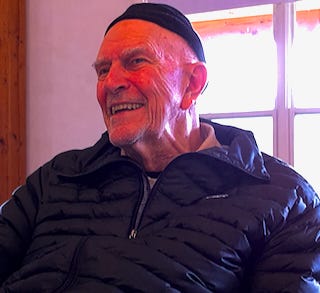
What follows is adapted from an interview conducted with me by Pamela Begeman as part of her Thomas Keating Oral History Project. She interviewed individuals who had a close relationships with him over the years. Later in this book I will also share teachings from informal talks by Fr. Thomas that I was fortunate to record.
First Encounter
Question: What was your first meeting with Fr. Thomas and how did your relationship evolve over the years?
Response: I recall the specific day I first met Thomas. I had only recently begun a centering prayer practice and after seeing his appearance on a public television (PBS) show called “God in American.” It was November 6, 1997, at a conference in Washington, DC., that was sponsored by Common Boundary, a magazine exploring psychology, spirituality, and creativity. It was their seventeenth annual conference.
The day before the conference, there was a pre-conference symposium on contemplative arts and practice featuring a panel of well-known contemplative teachers. Thomas represented the Christian tradition, Sharon Salzberg Buddhism, Rabbi Jonathan Omar-Man Judaism, and Kenneth Cohen Taoism. The topic for the panel was to address - what is contemplation? Each spoke about contemplation from their respective tradition. Looking back, it was probably my first meaningful exposure to an interspiritual gathering, though I would not have used that language at the time. After each spoke there was a break.
I went to the restroom, and as I was returning to the meeting room, Thomas was walking down the center aisle, presumably headed to the restroom. We passed each other silently. At the precise moment we crossed paths, he smiled —and I assume I smiled back. No words were exchanged, yet we held a steady eye contact for a few moments. What struck me was his presence. In my psychosynthesis training I had learned that people had a quality of presence, and his was unusually strong. It was as if he was shining. I did not regard the moment as mystical, nor did I label it in any way. But something significant was communicated in silence alone.
Later, when the panel reconvened for questions I asked Thomas, “since everyone has spoken about their understanding of contemplation as an experience-based reality, what’s the relationship between religious beliefs and contemplation?” His answer revealed a notable characteristic of his. Thomas rarely negated anything. Instead of dismissing or replacing another viewpoint, he somehow built upon it. He replied, “Beliefs are important, but once you experience what the belief points to the beliefs themselves become less relevant.” I liked his answer.
So, the first meeting was in silence, what I later jokingly referred as “the bathroom silence.” I have often thought it fitting that silence became both a cornerstone of his teaching and fertile ground upon which I sought to flourish; and it began our relationship.
Coffee Break with Thomas
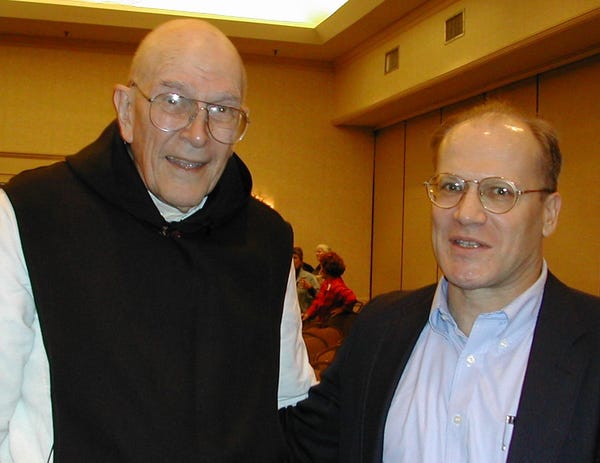
Our relationship evolved into verbal communication several years later. In 2002, after becoming a coordinator of our local chapter of Contemplative Outreach, I attended an annual meeting in Nashville that focused on ecumenism. It was there that I had a first one-on-one with Thomas. There was, again, a break in the proceedings, thank goodness for breaks, and I offered to buy Thomas a cup of coffee.”Oh, sure he said.” I learned later he actually preferred tea.
We walked to the hotel coffee shop, I bought our beverages, and we sat on a bench in the hallway. We chit-chatted, getting to know each other. At the time I had recently become a coordinator but did not attend church. I stopped going as I entered adolescence. I said I was worried my “unchurched” status might have a negative impact on Contemplative Outreach since people often asked of me: “What parish (or church) do you belong to? “ I said, “Thomas, not only am I not a Catholic, but I don’t go to church. I’m not in a parish.” It felt risky to say this out loud as we barely knew each other. Would he judge me? But I loved his simple and practical response. He said, “Well, when people ask, just tell them you’re not currently attending a church or parish.” It was so practical, no theology, no correction, no subtle pressure yet it was truthful. I felt I had found an ally.
Basil Pennington - Another Monk
It was five years after the Common Boundary conference. In 2000, I attended the annual meeting of Contemplative Outreach in Chicago. Fr. Basil Pennington was the guest speaker. I first met him one morning swimming laps in the hotel swimming pool. I remember he wore a Casio watch. Fr. Basil and Thomas were both discussed in Jacob Needleman’s influential book Lost Christianity that I had read with great interest.
Looking back, I sometimes laugh at how many spiritually significant encounters in my life seemed to occur around bathroom breaks, in hallways, and at swimming pools rather than formally designated sacred spaces.
At the time, Contemplative Outreach had just launched its first website, which felt revolutionary to many of us. Fr. Carl Arico was giving a presentation to coordinators and contact persons about this new development while I assisted with audio-visual support. Fr. Carl was doing his usual excellent job, and Fr. Basil, a big man physically and psychologically stood quietly in the back of the room. Then, unexpectedly, Fr. Basil began walking toward the podium. “Would anyone mind if I say a few things?” he asked. As far as we knew, this had not been planned.
What struck me was the absence of ego in the interruption. There seemed to be no competitiveness in it whatsoever. It felt fresh, spontaneous, pure, bold, and oddly courageous — this large bearded monk simply moved by something inwardly compelling. I no longer remember exactly what he said. But I remember the feeling of it.
It reminded me of something Fr. Carl once said Fr. Basil had told him: “Whenever people invite you to give a talk, whatever the topic, give the talk — but don’t leave until you teach them centering prayer.” That line also captured Fr. Basil perfectly.
Serving Together
While I encountered Thomas in many different settings over the years, the most sustained context came after I joined the Board of Contemplative Outreach. Thomas was still active at Board meetings, so many meetings involved extended periods together.
Over the years I came to see that what most distinguished Thomas was not simply his teachings, writings, or public fame nor stature. It was his presence — spacious, non-defensive, grounded, and deeply silent. One could feel in him a person who had gradually, through years of preparation become less identified with the human condition including the need to impress, persuade, or dominate. His silence was not emptiness. It was inhabited. He would say at times by the Holy Spirit.
And perhaps that is why my first encounter with him — a brief moment of presence and wordless silence — remained so memorable all these years later.
To be continued….
Thank You for this, Ron.
I met Thomas through his writing, and I spent many hours listening to his voice on The Spiritual Journey tapes. One very brief healing experience after practicing centering prayer for several years convinced me that his words were deeply rooted and pointing toward something infinite and beyond words.
Frank Pendola